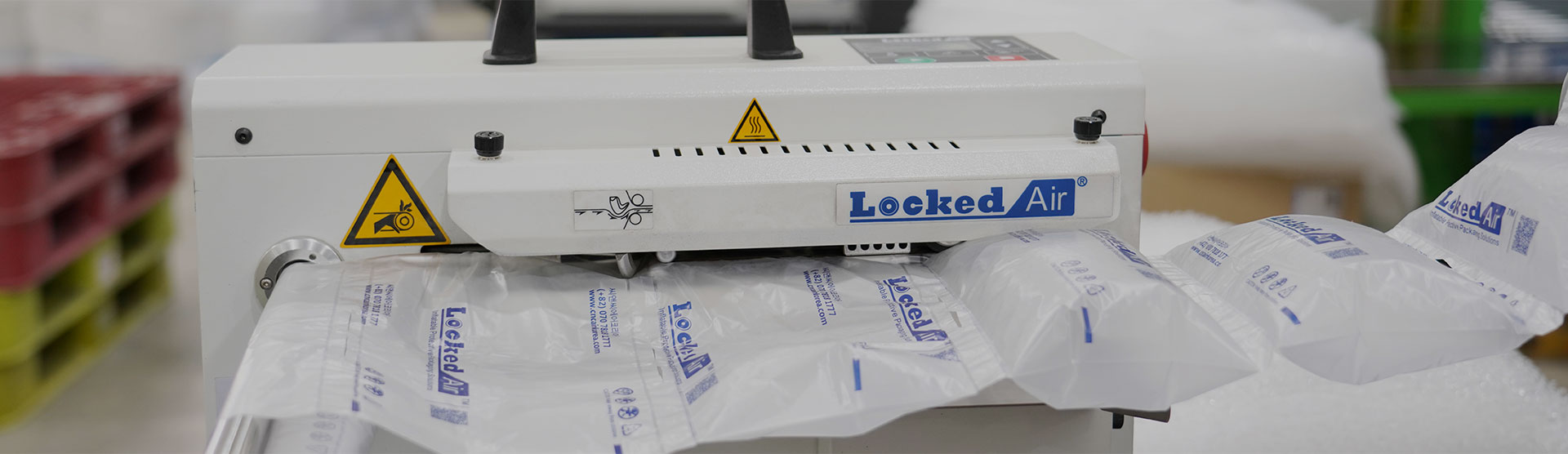
As a manufacturer with years of experience in the inflatable cushioning industry, we receive frequent soul-searching questions from procurement partners every day: "How long can your air pillows retain air?" "Will they deflate after half a month of sea shipping?" "Why do some inflatable cushions lose air gradually during use?"
In fact, the "air retention endurance" of air pillows never depends on luck, but hides 5 key secrets. Today, we won’t pile up professional jargon; instead, we’ll use the manufacturer’s down-to-earth words and a touch of fun to explain the core factors affecting air retention thoroughly, helping you avoid procurement pitfalls and choose truly "durable and long-lasting" inflatable air cushions!
I. Raw Material: The "Foundation of Air Retention" for Air Pillows – Choosing the Right One Is Half the Battle
Many procurement partners overlook one point: the air retention performance of air pillows first depends on their "origin" – that is, the raw material. It’s just like buying a thermos cup: the insulation effect of a glass inner liner is vastly different from that of an ordinary plastic inner liner, and the same goes for the material of air pillows.
Our factory’s actual tests have found that air pillows made of high-quality virgin PE material (food-grade standard) have a dense molecular structure, like adding an "airtight protective net" to the gas, with a negligible air leakage rate. In contrast, inferior recycled plastic has numerous tiny pores, allowing gas to escape like "fish slipping through a net" – even if just inflated, the gas will leak quietly.
Here’s a small tip for procurement partners: don’t just focus on price. Ask the manufacturer for a material test report. Virgin PE material is the "solid foundation" for air retention of air pillows – we want to save money, but more importantly, we want peace of mind!
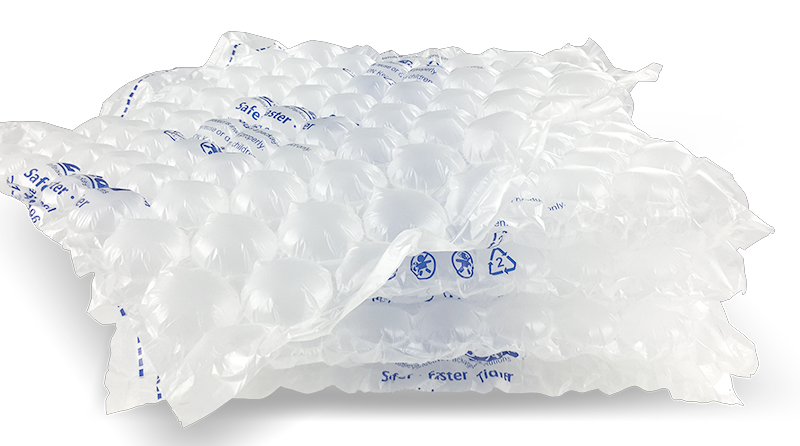
II. Film Thickness and Structure: The "Protective Armor" of Air Pillows – Thicker ≠ Better, Rationality Is Key
Many procurement partners fall into a misunderstanding: they think the thicker the air pillow film, the longer the air retention time. But that’s not the case! The film thickness and structural design emphasize "precise adaptation" rather than "the thicker the better."
For example, when packaging small and light items (such as jewelry and small electronic products), using overly thick film not only increases costs but also makes the air pillows stiff, which instead affects the cushioning effect. When packaging heavy items (such as home appliances and ceramics), thin film is easily punctured by sharp edges and corners, making air retention impossible.
Our factory’s core design is: according to different packaging scenarios, we match a precise thickness of 0.03-0.05mm, combined with a double-layer composite structure. This not only resists puncture but also firmly locks in gas, ensuring the air retention time of air pillows is stably more than 6 months, perfectly covering the cross-border sea shipping cycle.
III. Heat Sealing Process and Sealing Quality: The "Sealing Code" of Air Pillows – Air Leakage Depends Entirely on This
If material is the foundation and structure is the armor, then the heat sealing process is the "sealing lock" of air pillows – no matter how perfect the previous steps are, poor sealing makes everything in vain!
To save costs, many small manufacturers use ordinary heat sealing machines with uneven temperature control. As a result, the sealed edges are either not firm enough to be opened with a pinch, or too hard and prone to cracking, allowing gas to leak quietly from the gaps.
As a source air column bag manufacturer, we adopt a fully automatic constant temperature heat sealing process. Each sealed edge undergoes 3 rounds of inspection to ensure it is flat and tight. Even after repeated extrusion and bumping, there will be no air leakage or bag bursting. Simply put, a good heat sealing process is the "peace of mind guarantee" for air retention of air pillows!
IV. Inflation Pressure and Filling Standards: The "Inflation Secret" of Air Pillows – Correct Inflation Ensures Longevity
In addition to the product itself, inflation operation also affects air retention time – many procurement partners feedback that "air pillows leak quickly," but it’s actually not a product quality issue, but the wrong inflation method!
Over-inflation leads to excessive internal pressure of the air pillows, which accelerates gas leakage and makes them easy to be punctured by foreign objects. Under-inflation makes the air pillows soft, which not only fails to achieve the cushioning effect but also allows gas to "escape" slowly due to insufficient internal pressure.
Here’s our factory’s practical suggestion: control the inflation pressure at 0.05-0.08MPa. When filling, make the air pillows fit the inner wall of the carton with slight elasticity. This not only ensures the cushioning effect but also maximizes the air retention time, which can stably cope with both sea and land shipping!
V. Storage and Transportation Environment: The "Maintenance Guide" for Air Pillows – Details Determine Endurance
The last easily overlooked factor – the storage and transportation environment – also quietly affects the air retention time of air pillows. Just like our mobile phone batteries, high temperature and humidity accelerate wear and tear, and air pillows are equally "delicate."
If air pillows are stored in a high-temperature and humid warehouse for a long time, the film will age and become brittle faster, with increased pores, leading to a significant decline in air retention performance. During transportation, severe bumping and extrusion by sharp objects can also cause loose seals and damaged film, resulting in air leakage.
As a manufacturer, we not only provide high-quality products but also give thoughtful reminders to procurement partners: store air pillows in a cool and dry place away from direct sunlight; take protective measures during transportation to avoid extrusion and puncture. Only in this way can the "air retention endurance" of air pillows be maximized!
By now, we believe procurement partners understand: the air retention time of air pillows is never determined by a single factor, but by the "five-fold support" of material, structure, process, operation, and environment.
As a source manufacturer focusing on the inflatable cushioning field, each air pillow undergoes strict inspection. From raw materials to finished products, from process to after-sales service, we control every link to provide procurement partners with products that "have long air retention, strong protection, and high cost performance," helping you solve the trouble of goods damage and reduce procurement costs!
If you have any questions about air retention and selection of air pillows, feel free to contact us. We are a direct manufacturer with no middlemen, providing you with the most practical solutions~

 中文
中文